

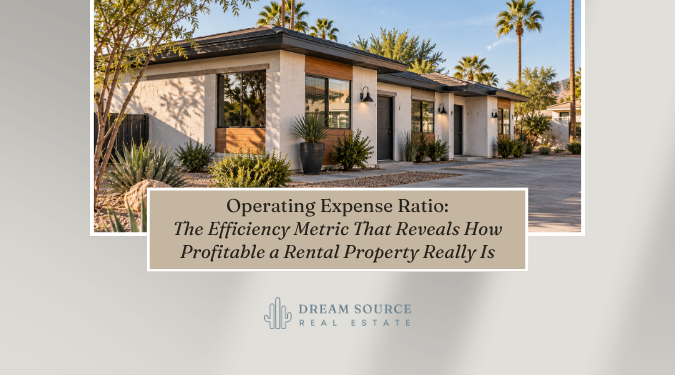
Two rental properties can have identical gross rent and produce very different returns. The reason usually comes down to expenses — and Operating Expense Ratio is the metric that makes that visible.
What Is OER?
Operating Expense Ratio measures the percentage of a property's gross operating income that gets consumed by operating expenses. It excludes mortgage payments and capital expenditures, which makes it a clean measure of operational efficiency.
The formula is:
OER = Operating Expenses ÷ Gross Operating Income
Operating expenses include property taxes, insurance, property management fees, repairs, maintenance, utilities paid by the owner, and vacancy allowance. What it doesn't include is your debt service — the mortgage — or major capital improvements.
A Phoenix Example
A Phoenix fourplex generates $60,000 in gross operating income and carries $27,000 in annual operating expenses.
$27,000 ÷ $60,000 = OER of 45%
That means 45 cents of every dollar of gross income goes toward expenses, leaving 55% — or $33,000 — as net operating income. The lower the OER, the more of the gross rent flows through to NOI, which directly affects cash flow, property value, and financing options.
What's a Normal OER in Phoenix?
In the Phoenix market, an OER of 35–50% is typical for stabilized single-family and small multifamily rentals. Where a property falls within that range depends on several factors:
- Newer construction tends to carry lower maintenance costs initially, though HOA fees can push OER higher in some communities
- Older properties with well-maintained systems and low turnover can sometimes run leaner on expenses despite their age
- Poorly managed properties often run high OERs due to deferred maintenance, excessive vacancy, or inefficient vendor relationships — all of which can be improved under new ownership
Why OER Matters When Evaluating a Deal
OER is one of the most useful metrics for comparing properties that look similar on the surface. Two fourplexes in the same Phoenix submarket, both renting for $60,000 per year, can have dramatically different NOIs depending on how efficiently they're operated.
A property with a 40% OER generates $36,000 in NOI. A property with a 55% OER generates only $27,000 — a $9,000 difference that flows directly into cap rate, cash-on-cash return, and the property's appraised value under income-based approaches.
OER is also a useful diagnostic when evaluating an existing Airbnb or rental with a history. If the current owner's OER is unusually high, it may signal a management or operational problem — not a property problem. That distinction can reveal value-add opportunity for a buyer who knows how to run a tighter operation.
The Bottom Line
OER is about efficiency. It tells you how much of a property's income actually makes it to the bottom line — and comparing it across properties helps you identify which ones are operating well and which ones have room to improve.
If you'd like help analyzing OER on a specific Phoenix property or want to understand how expense structure affects the overall investment case, I'd be happy to walk through it with you.
Thinking about buying an investment property in Arizona?
Before you make an offer, I'll provide a professional underwriting analysis so you can understand the property's cash flow, appreciation potential, financing impact, and long-term return. Send me the address, and I'll review it with you — [email protected].
Brian Harris | Investor-Friendly Real Estate Advisor | Dream Source Real Estate
📍 Serving Phoenix, Scottsdale, Glendale, Peoria, Mesa, Chandler & surrounding areas
📞 602-684-0198 📧 [email protected] 🌐 azdreamsource.com
Check out this article next