

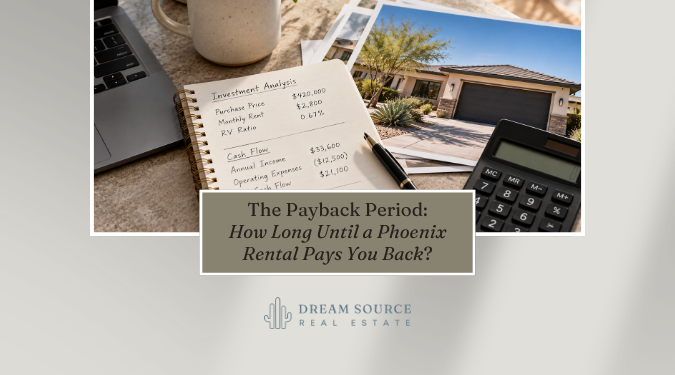
Every investor wants to know the same thing before buying a rental: how long until my money comes back to me? The Payback Period answers that question directly, and it's one of the simplest ways to compare the risk and timeline of different deals.
What Is the Payback Period?
The Payback Period measures how long it takes to earn back your original cash investment from a property's annual net cash flow. It turns a deal's numbers into a timeline you can plan around.
The formula is simple:
Payback Period = Initial Investment ÷ Annual Net Cash Flow
Why the Payback Period Matters
Simple risk indicator: It shows how quickly your invested capital returns to you.
Liquidity gauge: A shorter payback generally means lower risk, especially for investors who value getting their cash back sooner.
Goal tracker: It's useful for planning reinvestment and comparing timelines across deals.
A Phoenix Example
Consider a Phoenix rental home:
Initial Investment: $150,000
Annual Net Cash Flow: $20,000
Payback Period = $150,000 ÷ $20,000 = 7.5 years
That means it takes about 7.5 years to recoup your invested capital. That figure doesn't include appreciation or tax benefits, both of which can meaningfully improve your total return.
What's a Typical Payback Period in Phoenix?
Buy-and-hold investors in Phoenix typically target a payback period of 6 to 9 years. High cash-flow properties can shorten that window to 5 years or less.
Appreciation-focused areas like Scottsdale or Norterra often take longer to pay back through cash flow alone, but they can offset that with stronger value growth over time. As with most investment metrics, the right target depends on your strategy. An investor prioritizing income and capital recovery will weigh payback differently than one focused on long-term equity.
What the Payback Period Doesn't Tell You
The Payback Period is intentionally simple, which also means it leaves things out. It doesn't account for appreciation, tax benefits, loan paydown, or the time value of money. It also says nothing about what happens after your capital is recovered.
That's why it works best alongside other metrics:
IRR (Internal Rate of Return): Your total annualized return over the full holding period.
Cash-on-Cash Return: Annual pre-tax cash flow relative to the cash you actually invest.
Cap Rate: Net operating income relative to the property's value.
The Bigger Question
The Payback Period gives you a clear timeline for risk and return. Used with IRR, Cash-on-Cash, and Cap Rate, it helps complete your investment picture.
If you'd like help mapping out the payback timeline on a specific Phoenix property, I'd be happy to run the numbers and plan your reinvestments to keep your capital compounding.
Thinking about buying an investment property in Arizona?
Before you make an offer, I'll provide a professional underwriting analysis so you can understand the property's cash flow, appreciation potential, financing impact, and long-term return. Send me the address, and I'll review it with you — [email protected].
Brian Harris | Investor-Friendly Real Estate Advisor | Dream Source Real Estate
📍 Serving Phoenix, Scottsdale, Glendale, Peoria, Mesa, Chandler & surrounding areas
📞 602-684-0198 📧 [email protected] 🌐 azdreamsource.com
Check out this article next