

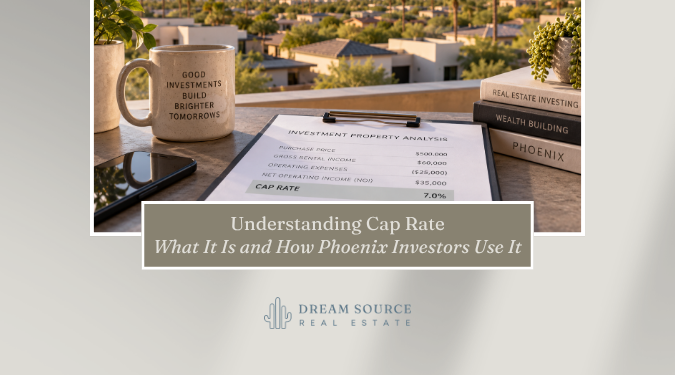
If you're evaluating investment properties in Phoenix, cap rate is one of the first metrics you'll encounter — and one of the most frequently misunderstood. Here's what it actually means and how to use it effectively.
What Is Cap Rate?
Cap rate, short for capitalization rate, measures the expected annual return on an investment property based on the income it generates — without factoring in debt or financing.
The formula is straightforward:
Cap Rate = Net Operating Income (NOI) ÷ Purchase Price (or Current Market Value)
Net Operating Income is the property's annual income after operating expenses — things like property taxes, insurance, property management, maintenance, and vacancy — but before mortgage payments.
Why Cap Rate Matters
Cap rate is useful for a few specific reasons:
- Quick comparisons — It lets you evaluate multiple properties on a level playing field, regardless of size or price point. A property generating a 7% cap rate is producing more income relative to its price than one generating 5%.
- Financing-neutral — Because it ignores your mortgage, cap rate reflects the performance of the asset itself, not how you're funding the purchase. That makes it a clean baseline for comparison.
- Risk indicator — Higher cap rates generally signal higher potential returns, but often come with more risk — less desirable locations, older properties, or less stable tenants. Lower cap rates typically reflect stability, strong demand, and lower risk.
A Simple Phoenix Example
You're evaluating a Phoenix duplex priced at $500,000. It generates $35,000 per year in net operating income after expenses.
$35,000 ÷ $500,000 = 7% cap rate
That 7% represents your expected annual return if you purchased the property in cash with no financing. You can use that number to compare this property against others in the Phoenix market and quickly identify which opportunities are priced appropriately for the return they're offering.
What's a Good Cap Rate in Phoenix?
In the Phoenix market, cap rates typically range from 5–8% depending on location, property condition, and tenant quality.
A lower cap rate isn't necessarily bad. In high-demand neighborhoods or areas with strong long-term appreciation potential — like parts of Scottsdale or the East Valley — investors often accept a lower cap rate because the overall return picture, including appreciation, is still compelling.
A higher cap rate can mean better short-term cash flow, but it may also reflect a property that carries more risk — older systems, a less desirable submarket, or tenants that require more active management.
Context is everything.
What Cap Rate Doesn't Tell You
Cap rate is a valuable starting point, but it has real limitations. It doesn't account for your financing costs, which significantly affect actual cash flow. It doesn't capture appreciation potential. And it doesn't reflect the quality of the tenants, the age of the mechanical systems, or a dozen other factors that affect the real-world performance of a property.
Smart investors use cap rate as one tool in a broader analysis — paired with cash-on-cash return, DSCR, total return modeling, and a clear understanding of the submarket.
If you'd like help evaluating cap rates on specific Phoenix properties or want to understand how a property's return profile fits your investment goals, I'd be happy to walk through the numbers with you.
Thinking about buying an investment property in Arizona?
Before you make an offer, I'll provide a professional underwriting analysis so you can understand the property's cash flow, appreciation potential, financing impact, and long-term return. Send me the address, and I'll review it with you — [email protected].
Brian Harris | Investor-Friendly Real Estate Advisor | Dream Source Real Estate
📍 Serving Phoenix, Scottsdale, Glendale, Peoria, Mesa, Chandler & surrounding areas
📞 602-684-0198 📧 [email protected] 🌐 azdreamsource.com
Check out this article next