
Cap rate tells you how a property performs as an asset. Cash-on-cash return tells you how your money is performing as an investment. They're related — but they answer different questions, and for most leveraged investors, cash-on-cash return is the more practical of the two.
What Is Cash-on-Cash Return?
Cash-on-cash return measures the annual return you're earning on the actual cash you put into a property — your down payment, closing costs, and any upfront capital.
The formula is simple:
Cash-on-Cash Return = Annual Pre-Tax Cash Flow ÷ Total Cash Invested
Unlike cap rate, which ignores financing, cash-on-cash return reflects the reality of how most investors actually buy property — with a mortgage. That makes it a more direct measure of how hard your dollars are working.
A Phoenix Fourplex Example
Here's how it plays out with a real set of numbers:
- Purchase Price: $800,000
- Down Payment: $160,000
- Closing Costs: $10,000
- Total Cash Invested: $170,000
- Annual Pre-Tax Cash Flow: $20,400
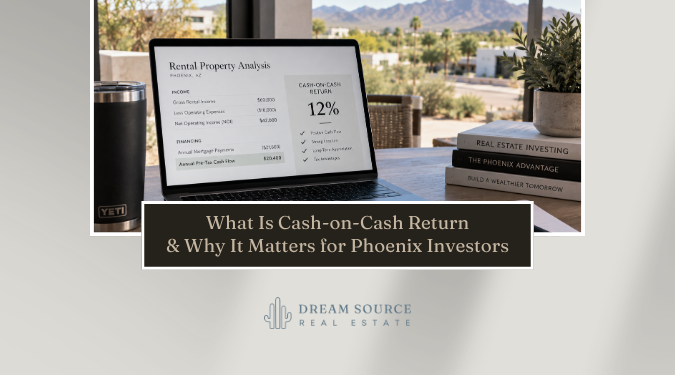
$20,400 ÷ $170,000 = 12% cash-on-cash return
That 12% means your invested capital is generating a 12% annual return before taxes — purely from the cash flow the property produces after the mortgage and operating expenses are paid.
Why Cash-on-Cash Return Matters
There are a few reasons this metric is especially useful for investors:
- It's investor-focused — Cap rate measures the property's performance. Cash-on-cash return measures your return on the specific capital you deployed. Those are meaningfully different questions.
- It shows the impact of leverage — Because financing is built into the calculation, it reveals how using a mortgage can amplify your returns on invested cash compared to buying a property outright.
- It's a practical comparison tool — When evaluating multiple opportunities, cash-on-cash return lets you quickly see which deal puts your capital to work most efficiently.
What's a Good Cash-on-Cash Return in Phoenix?
In the Phoenix market, 8–12% is a reasonable target range for well-located multifamily and small income-producing properties. Returns above that are possible but often come with trade-offs — more management intensity, older properties, less desirable locations, or higher tenant turnover risk.
As with cap rate, context matters. A 9% cash-on-cash return in a high-demand Phoenix submarket with strong appreciation potential may be a better overall investment than a 13% return in a location with weaker fundamentals.
What Cash-on-Cash Return Doesn't Capture
Cash-on-cash return is a useful snapshot, but it's not the full picture. It doesn't account for appreciation, loan paydown, or tax benefits — three of the other major ways a rental property builds wealth over time. It also reflects a single point in time and will change as rents rise, expenses shift, or financing is refinanced.
The strongest investment decisions combine cash-on-cash return with cap rate, total return modeling, and a clear understanding of where the property fits in your long-term strategy.
If you'd like help running cash-on-cash return on a specific Phoenix property — or want to see how different financing scenarios affect the number — I'd be happy to walk through it with you.
Thinking about buying an investment property in Arizona?
Before you make an offer, I'll provide a professional underwriting analysis so you can understand the property's cash flow, appreciation potential, financing impact, and long-term return. Send me the address, and I'll review it with you — [email protected].
Brian Harris | Investor-Friendly Real Estate Advisor | Dream Source Real Estate
📍 Serving Phoenix, Scottsdale, Glendale, Peoria, Mesa, Chandler & surrounding areas
📞 602-684-0198 📧 [email protected] 🌐 azdreamsource.com
Check out this article next